
FLIP in February 2026: 7.3 Million Tokens Burned, Staking Yields Up to 14.39% APY
As of February 2026, Chainflip has burned 7.3M FLIP tokens through swap fees, with staking yields up to 14.39% APY. Full breakdown of tokenomics, validator auctions, governance, and where to buy FLIP.


As of February 19, 2026, Chainflip has burned 7.3 million FLIP tokens through swap fee revenue, with burns accelerating as protocol volume grows. Here is a full picture of where the token stands today.
FLIP Powers Chainflip's Validator Network and Returns Value to Holders
FLIP is the native token of the Chainflip protocol, a decentralized crosschain exchange handling native swaps between Bitcoin, Ethereum, Solana, and more. It serves three functions: securing the network through validator collateral, capturing protocol fee revenue through a buyback and burn mechanism, and giving holders a way to earn yield through delegation.
Without FLIP staked across 150 validators, there are no swaps. Without swaps, there are no burns.
7.3 Million FLIP Burned and Counting: How the Supply Model Works
Chainflip has processed $6.45B in all-time volume across over 2 million swaps, generating $8M in broker fees. That activity has driven a significant burn:
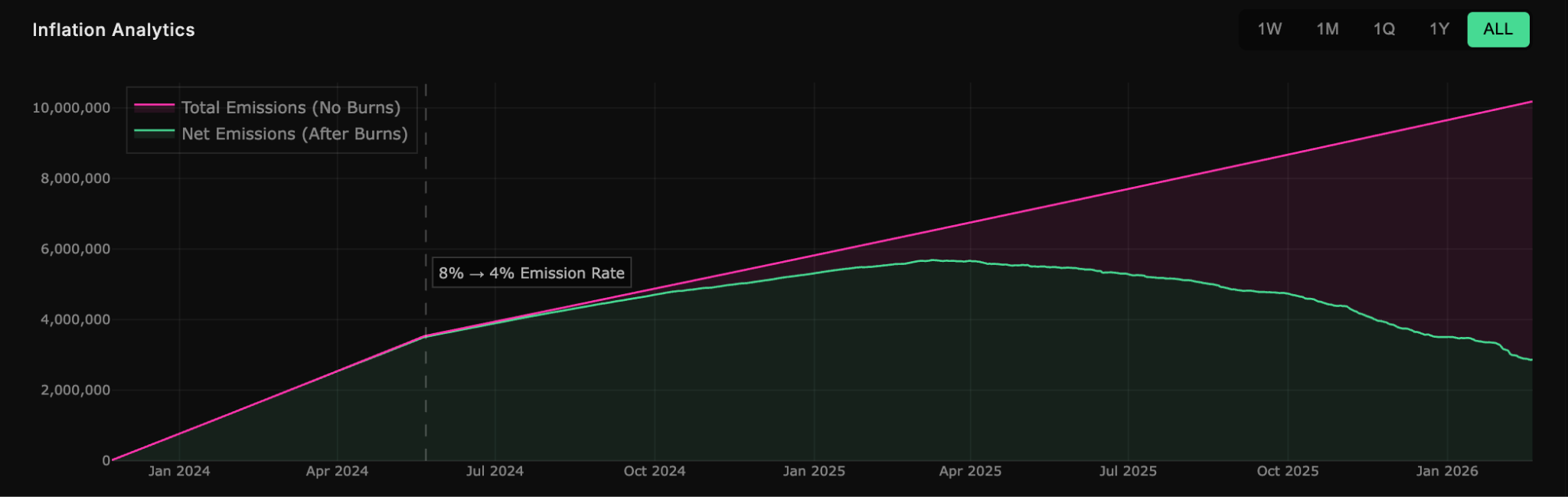
As of February 19, 2026, burnonomics.com shows all-time figures:
- Total supply: 92,791,881 FLIP
- Circulating supply: 66,165,912 FLIP
- Bought and burned: 7,313,472 FLIP
- Emissions: 10,183,420 FLIP
- Net supply change: +2,869,948 FLIP
- Percent staked: 56.45%
On an all-time basis, emissions have outpaced burns, resulting in a net supply increase of roughly 2.9 million tokens. The protocol is currently inflationary overall. However, burns are scaling directly with swap volume. As Chainflip's crosschain swap volume continues to grow, the gap between emissions and burns narrows.
To put the burn figure in context: Uniswap's UNI token has no fee capture mechanism at the protocol level. THORChain's RUNE uses a reserve model with less transparent burn mechanics. Chainflip's buy-and-burn is direct: swap fees purchase FLIP from the open market and permanently remove it from circulating supply. Every BTC to SOL swap, every ETH to USDC trade, every stablecoin route contributes to the burn.
More Swap Volume Means More FLIP Removed from Circulation
The Chainflip token page displays FLIP burnt as a top-line protocol metric alongside total volume and swap count. That positioning is deliberate. Protocol usage and token supply are directly connected.
The burn model works as follows: a portion of the fees generated by every crosschain swap on Chainflip is used to buy FLIP from the open market. That FLIP is then permanently removed from circulating supply. No governance vote required, no treasury discretion. It happens automatically as part of the protocol's fee distribution logic, tracked in real time at burnonomics.com.
Emissions are currently fixed and do not scale with volume. Burns do. As swap activity grows, the burn rate increases while emissions remain constant, meaning the gap between the two closes over time. The roadmap also includes emissions reduction as a planned step, which would accelerate this further.
With 56.45% of circulating supply currently staked, the effective liquid supply available on the open market is significantly smaller than the circulating figure suggests.
How Chainflip's Validator Auction System Works
Chainflip operates with up to 150 active validators at any time. Validators compete in weekly auctions to secure a slot in the authority set. To participate, they must bond FLIP as collateral.
The auction system determines which validators are active based on the size of their FLIP bond. Higher bids win slots. Validators that don't win are in a backup pool. This creates continuous, competitive demand for FLIP from node operators who want to stay active and earn rewards.
This mechanic is what makes 56.45% of circulating supply locked in validator stakes. It is not passive holding. It is collateral with real consequences: validators who act dishonestly or go offline risk losing their stake.
The auction-driven model also means staking APY fluctuates. When more FLIP is staked across the network, individual rewards dilute. When volume rises and fee revenue increases, yields go up. Both variables move over time, which is why checking auctions.chainflip.io for the current rate matters before committing.
Delegating FLIP Today Earns Up to 14.39% APY
Not everyone wants to run a validator node. Delegation lets any FLIP holder stake to an existing validator and earn a share of their rewards, without running infrastructure.
As of February 19, 2026, delegation yields up to 14.39% APY. Validator operators running their own nodes can earn up to 48% APY, with delegation from other holders boosting their capacity and yield further.
To delegate: connect a wallet at auctions.chainflip.io/delegate, select a validator, and stake FLIP directly. The process is noncustodial. Assets remain secured by the validator set, not a centralized intermediary.
Staking rewards come from two sources: protocol emissions (new FLIP minted as validator incentives) and fee revenue generated by swap activity. As volume grows, the fee revenue component increases, which supports yields even if emissions are reduced over time.
FLIP Holders Can Vote on Protocol Governance Directly
FLIP is also a governance token. Any FLIP holder with a State Chain balance can vote on governance proposals, including those with tokens currently staked to validators.
A 2/3rd supermajority is required for a proposal to pass. Proposals run for 7 days and are subject to a 14-day cooldown before new governance keys take effect. This window gives the community time to assess changes before they go live, and gives liquidity providers the option to withdraw if they disagree with the direction.
Chainflip uses two governance keys. The Governance Key is held by Chainflip Labs' Security Council (a 3-of-6 multisig). The Community Key is held by 9 independent non-Labs members, 5 of whom must sign. Neither key can act unilaterally on the most sensitive protocol functions. Both must agree for major changes to proceed.
Where to Buy FLIP
FLIP is available across both decentralized and centralized venues:
Decentralized:
- Chainflip - Swap native assets directly to FLIP, no wallet connection required
- Uniswap - ERC-20 FLIP via Ethereum liquidity pools
Centralized:
- Bybit - Spot trading for FLIP
- Gate.io - FLIP spot and trading pairs
- KuCoin - FLIP spot markets
- Crypto.com - Buy and trade FLIP
Aggregators:
- Shapeshift - Multichain wallet and aggregator with FLIP support
FLIP contract addresses and on-chain analytics are available on CoinGecko, CoinMarketCap, and Etherscan.
What Is Coming Next for FLIP
The Chainflip token roadmap outlines several upcoming changes to the token model:
A fixed token supply model is planned, designed to drive value to active network participants by capping total issuance. Alongside this, emissions reduction or removal is under consideration, which would make the burn-driven deflationary pressure more pronounced. A protocol fee distribution system is also in development, intended to reward active participants directly from fee revenue rather than purely from emissions.
These changes are not yet live. They are roadmap items and should be assessed as such.
Resources
- Swap Now - Start swapping native assets
- Lend BTC - Borrow against native Bitcoin
- Blog - Product updates and announcements
- Chainflip Scan - Track swaps and network activity
- Website - Explore Chainflip
Other Chainflip Products:
- Boost - Earn fees by providing single-sided liquidity with no IL risk
- Stablecoin Strategies - Deposit stablecoins and earn optimized yields
- Provide Liquidity - Supply assets to Chainflip's liquidity pools
- Stake FLIP - Delegate FLIP and earn staking rewards
Find us:
- Discord - Join the Chainflip community
- Telegram - Get the latest Chainflip updates
- X - Follow Chainflip on X
- LinkedIn - Chainflip on LinkedIn
- YouTube - Chainflip tutorials and explainers
- Bluesky - Follow Chainflip on Bluesky
FAQ
What is FLIP used for?
FLIP secures the Chainflip validator network as collateral, gets bought and burned using swap fee revenue, and lets holders earn yield by delegating to active validators or running their own node.
How does the FLIP burn mechanism work?
A portion of swap fees is used to buy FLIP from the open market and permanently remove it from circulation. All-time, 7.3 million FLIP has been burned. Burns scale with swap volume, meaning the burn rate increases as Chainflip processes more crosschain trades.
What APY can I earn by staking FLIP?
Delegation yields up to 14.39% APY as of February 19, 2026. Validator operators running their own nodes can earn up to 48% APY. Rates fluctuate based on total staked supply and protocol fee revenue. Check auctions.chainflip.io/delegate for the current rate.
Can I vote on governance without running a validator?
Yes. Any FLIP holder with a State Chain balance can vote on governance proposals, including those with staked tokens.
Is FLIP inflationary or deflationary?
Currently inflationary on an all-time basis. Emissions total 10.2 million FLIP against 7.3 million burned, resulting in a net supply increase of roughly 2.9 million tokens, per burnonomics.com. Burns scale with swap volume, so the gap narrows as protocol activity grows. The roadmap also includes emissions reduction as a planned step.
Where can I buy FLIP?
FLIP is available on Chainflip, Uniswap, Bybit, Gate.io, KuCoin, Crypto.com, and Shapeshift. See the full list with links in the "Where to Buy" section above.
What is changing for FLIP in the future?
The roadmap includes a fixed token supply model, emissions reduction, and a direct fee distribution system for active participants. These are planned features and not yet live.