
The $50M Swap That Exposed a Gap in DeFi Infrastructure
A $50M swap on Aave returned just 324 AAVE (roughly $35,000). Here's what went wrong, why it's a structural problem in DeFi, and how Chainflip handles large cross-chain swaps differently.

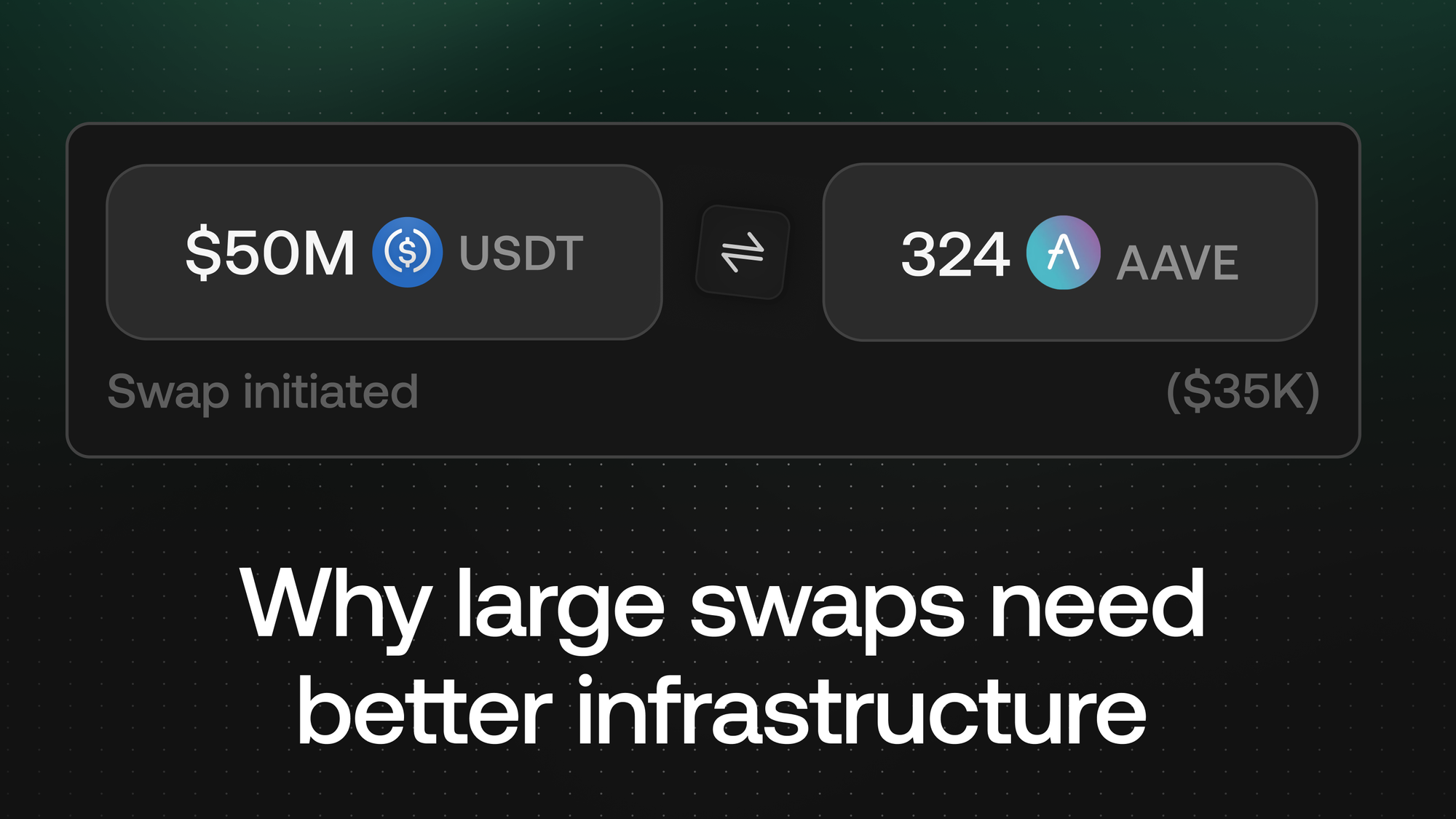
A user attempted to swap $50 million USDT for AAVE through the Aave interface. They received 324 AAVE in return, worth roughly $35,000. The transaction consumed the rest in slippage.
This wasn't a hack. It wasn't a bug. The protocol worked exactly as designed. That's what makes it worth understanding.
What actually happened
The Aave interface routed the trade through CoW Protocol, a DEX aggregator that sources liquidity across public and private liquidity sources. For a $50M order, the price impact was severe. The interface warned the user about extraordinary slippage and required a confirmation checkbox before proceeding.
The user confirmed on mobile and the transaction went through.
Stani Kulechov, Aave's founder, confirmed the CoW Swap routers functioned correctly and that the integration followed standard industry practices. Aave offered to return $600K in fees collected from the transaction, a goodwill gesture, not an admission of failure.
Earlier today, a user attempted to buy AAVE using $50M USDT through the Aave interface.
— Stani.eth (@StaniKulechov) March 12, 2026
Given the unusually large size of the single order, the Aave interface, like most trading interfaces, warned the user about extraordinary slippage and required confirmation via a checkbox.…
The honest takeaway: the system worked as built. Most AMM-based interfaces aren't built to handle a $50M single-asset market order on a relatively illiquid pool.
Why this is a structural problem, not a UI problem
The instinct is to blame the interface: a clearer warning, a bigger confirmation dialog, a mandatory delay. And those things help at the margins.
But the root issue is architectural. CoW Protocol isn't a simple AMM, it's a DEX aggregator that routes through virtually every major public and private liquidity source simultaneously. It already tried to find the best execution across the entire market. The problem wasn't routing. It's that no combination of existing DeFi liquidity was deep enough to absorb a $50M single-asset market order at a reasonable price. That's a structural ceiling, not a configuration error.
Statement from CoW Protocol:
— CoW DAO (@CoWSwap) March 13, 2026
Earlier today, a trader attempted to swap 50M aEthUSDT for aEthAAVE through Aave's swap interface, which is powered by CoW Protocol. Despite clear warnings that showed the user they would lose nearly all of the value of their transaction, and despite… https://t.co/Pav4udXUkX
On a pool with $20M in total liquidity, a $50M buy order will consume the pool's entire supply of the asset you want, and then some. The math works out to a price that bears no resemblance to the market rate.
nobody accidentally swaps $50M into a pool with $36K of liquidity lol. fresh wallet, $50.4M from Binance, zero slippage protection, routed through the jankiest Sushiswap path possible. and then an MEV bot just happens to flash borrow $29M from Morpho in the same block and pocket… https://t.co/Pbk1bOFbSs
— Vadim (@zacodil) March 12, 2026
This is known as price impact, and every AMM has it. The question is whether the system around the AMM is equipped to handle it.
How Chainflip approaches this differently
Chainflip is built for cross-chain swaps, so the context is different. Users aren't swapping USDT for AAVE on a single chain. But the underlying design choices address exactly the kind of failure mode demonstrated here.
Native cross-chain liquidity with JIT market making
Chainflip uses a Just-in-Time (JIT) liquidity model. When a large swap comes in, market makers can observe the incoming order and provide liquidity specifically for that trade at competitive rates. This is fundamentally different from a static AMM pool where the liquidity is fixed at the time of the trade.
For large orders, JIT liquidity means the trade can be partially or fully absorbed by active market makers quoting tighter spreads, rather than grinding through a fixed pool until the price is unrecognizable.
Slippage tolerance is set by the user upfront, not confirmed mid-flow
On Chainflip, users set a maximum slippage tolerance before submitting a swap. The protection is defined before the transaction is committed, not surfaced as a last-minute warning after execution has already been quoted badly.
Large swaps benefit from better price discovery
Because Chainflip's liquidity is aggregated across a JIT pool and a range-order AMM, large trades are less likely to fully drain a single pool. Market makers are incentivized to compete on larger orders where the fee opportunity is greater, which means the depth available for a $50M swap is meaningfully different from a $5K swap.
It's worth noting that Chainflip's products are currently focused on cross-chain asset swaps (native BTC, ETH, stablecoins across chains), not single-chain token swaps like USDT to AAVE. But the design principles that protect against this kind of slippage event are built into the protocol at a foundational level.
Best breakdown of what happened on a technical level, other than the theories around complex laundering motivations.
— paperX | THORSwap (@paperX_Art) March 13, 2026
RFQ/intent based models could have helped to avoid this as simply no quote will be returned.@THORChain/ @Maya_Protocol Streaming/ @Chainflip DCA could have… https://t.co/jsRvGyAj4M
What this incident reveals about DeFi UX
A user with $50M in assets had no reliable way to know, before submitting that transaction, what they would actually receive. The slippage warning is a necessary disclosure, but a checkbox confirmation on a mobile screen is not a substitute for a system that prevents catastrophic outcomes.
the redesign that could have saved an @aave user $50.4M pic.twitter.com/JAywNycHGu
— ✳︎ huge (@hugofromonline) March 13, 2026
This is a design question as much as a technical one. DeFi has normalized the idea that users bear full responsibility for understanding price impact before transacting. That's technically true, but it puts a significant burden on users that the interface is supposed to help them meet, and often doesn't.
Better swap infrastructure should make the likely outcome transparent before the transaction is committed, not just warn that things could go badly.
The takeaway for large swaps
If you're moving significant size in DeFi, a few principles apply regardless of which protocol you use:
Check execution price, not just slippage tolerance. Slippage % can look small while the absolute dollar impact is enormous on a large trade.
Use limit orders or split large trades. Most DEX aggregators support limit orders or allow breaking a large order into smaller tranches. A $50M trade executed in ten $5M chunks over several blocks will typically get better execution.
Check pool depth before trading. On most DEX interfaces and aggregators, pool depth is visible. If the pool's total liquidity is smaller than your trade size, execution will be bad.
Use infrastructure built for institutional-scale orders. Protocols with JIT liquidity, RFQ systems, or off-chain order books are better equipped for large trades than standard AMMs.
Chainflip's swap interface routes through protocol-level liquidity with slippage protection built in from the start. For cross-chain swaps at any size, that design matters.
Resources
- Swap Now - Start swapping native assets
- Lend BTC - Borrow against native Bitcoin
- Blog - Product updates and announcements
- Chainflip Scan - Track swaps and network activity
- Website - Explore Chainflip
Other Chainflip Products:
- Boost - Earn fees by providing single-sided liquidity with no IL risk
- Stablecoin Strategies - Deposit stablecoins and earn optimized yields
- Provide Liquidity - Supply assets to Chainflip's liquidity pools
- Stake FLIP - Delegate FLIP and earn staking rewards
Find us:
- Discord - Join the Chainflip community
- Telegram - Get the latest Chainflip updates
- X - Follow Chainflip on X
- LinkedIn - Chainflip on LinkedIn
- YouTube - Chainflip tutorials and explainers
- Threads - Follow Chainflip on Threads
- Bluesky - Follow Chainflip on Bluesky
Frequently asked questions
Why did the Aave swap result in such bad execution on a $50M trade? The swap was routed through an AMM pool with limited liquidity depth. A $50M buy order on a pool that couldn't absorb it moved the price dramatically, resulting in most of the input value being lost to slippage. The interface warned about high slippage, but the transaction proceeded after the user confirmed.
What is price impact in DeFi swaps? Price impact is the difference between the current market price and the price you actually receive because your trade moves the market. On AMMs, large trades relative to pool depth cause significant price impact. It's separate from gas fees or protocol fees.
How does Chainflip protect against slippage on large swaps? Chainflip uses a JIT (Just-in-Time) liquidity model where market makers can compete on incoming orders. Users also set a maximum slippage tolerance before submitting rather than confirming a bad outcome after the fact.
Can you swap large amounts safely on Chainflip? Chainflip's liquidity model is designed to handle larger order sizes more efficiently than static AMM pools, because JIT market makers can quote directly on sizeable orders. For very large swaps, reaching out to the team or using limit-order features is recommended.
What's the difference between slippage tolerance and price impact? Slippage tolerance is a user-set parameter defining the maximum acceptable deviation from the quoted price. Price impact is the actual market movement caused by your trade. On large trades, price impact can far exceed what slippage warnings adequately communicate.