
What is Chainflip? The Complete Guide to Native Cross-Chain Swaps


Chainflip is a decentralised cross-chain swap protocol that lets you trade native Bitcoin, Ethereum, Solana, and other assets directly across blockchains. No wrapped tokens. No bridges. No KYC.
You want to swap Bitcoin for Ethereum. Traditionally, you'd need a centralised exchange (with KYC and custody risk), a bridge (with smart contract risk and wrapped tokens), or a complex multi-step process involving several protocols.
Chainflip removes all of that. One transaction. Native assets in, native assets out. No account creation. No wrapped tokens. No bridge dependencies.
This guide covers how Chainflip works, why it exists, what makes it different from bridges and wrapped token solutions, and when it makes sense to use.
The Problem Chainflip Solves
Blockchains don't talk to each other natively. Bitcoin can't see Ethereum. Solana doesn't know what's happening on Arbitrum. This creates three major problems for anyone trying to move value across chains.
Bridge Risk
Traditional bridges lock your assets on one chain and mint wrapped representations on another. More than $2 billion has been lost to bridge hacks since 2021. When a bridge gets exploited, the wrapped tokens become unbacked. Your wBTC is only worth what someone will pay for it if the underlying BTC vault is drained.
Wrapped Token Complexity
Wrapped assets introduce custodial dependencies. Someone has to hold the real Bitcoin while wBTC circulates on Ethereum. That someone can be a multisig, a DAO, or a centralised entity. All create trust assumptions. Wrapped tokens can also depeg during market stress or lose backing entirely if the custodian is compromised.
Terrible User Experience
Most cross-chain solutions require multiple steps: connect wallet, approve bridge contract, wait for confirmation, claim on destination chain, sometimes manually add token addresses. Each step introduces friction and potential failure points.
Chainflip eliminates these problems.
How Chainflip Works
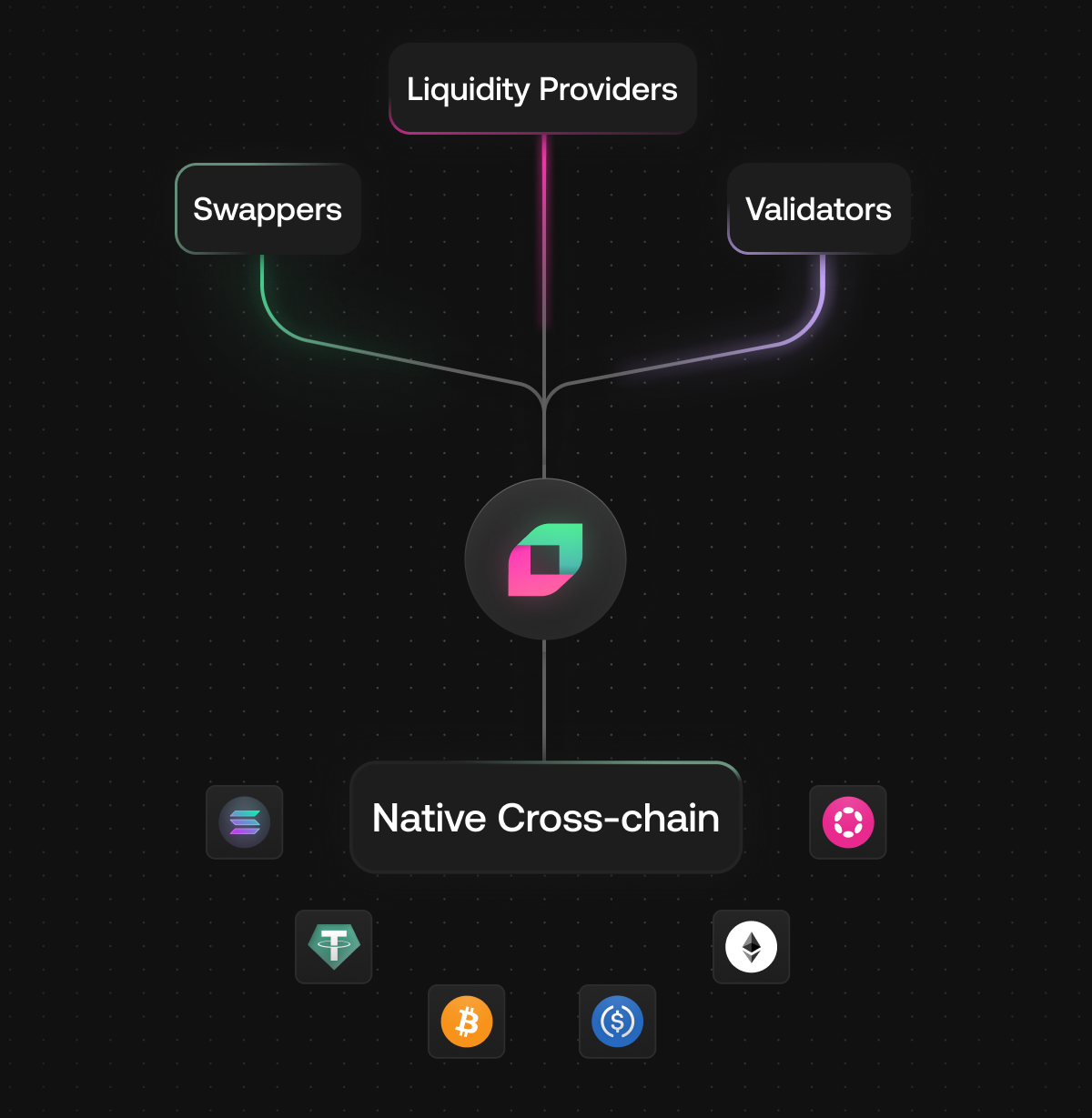
Chainflip operates as decentralised infrastructure with three core components: a validator network, multi-chain vaults, and a JIT (Just-In-Time) AMM.
The State Chain
Chainflip runs on its own blockchain called the State Chain, built on Substrate. This chain handles all swap logic, accounting, and coordination. It doesn't process the actual asset transfers. Those happen natively on Bitcoin, Ethereum, Solana, and other integrated chains. The State Chain just tracks balances and orchestrates the flow.
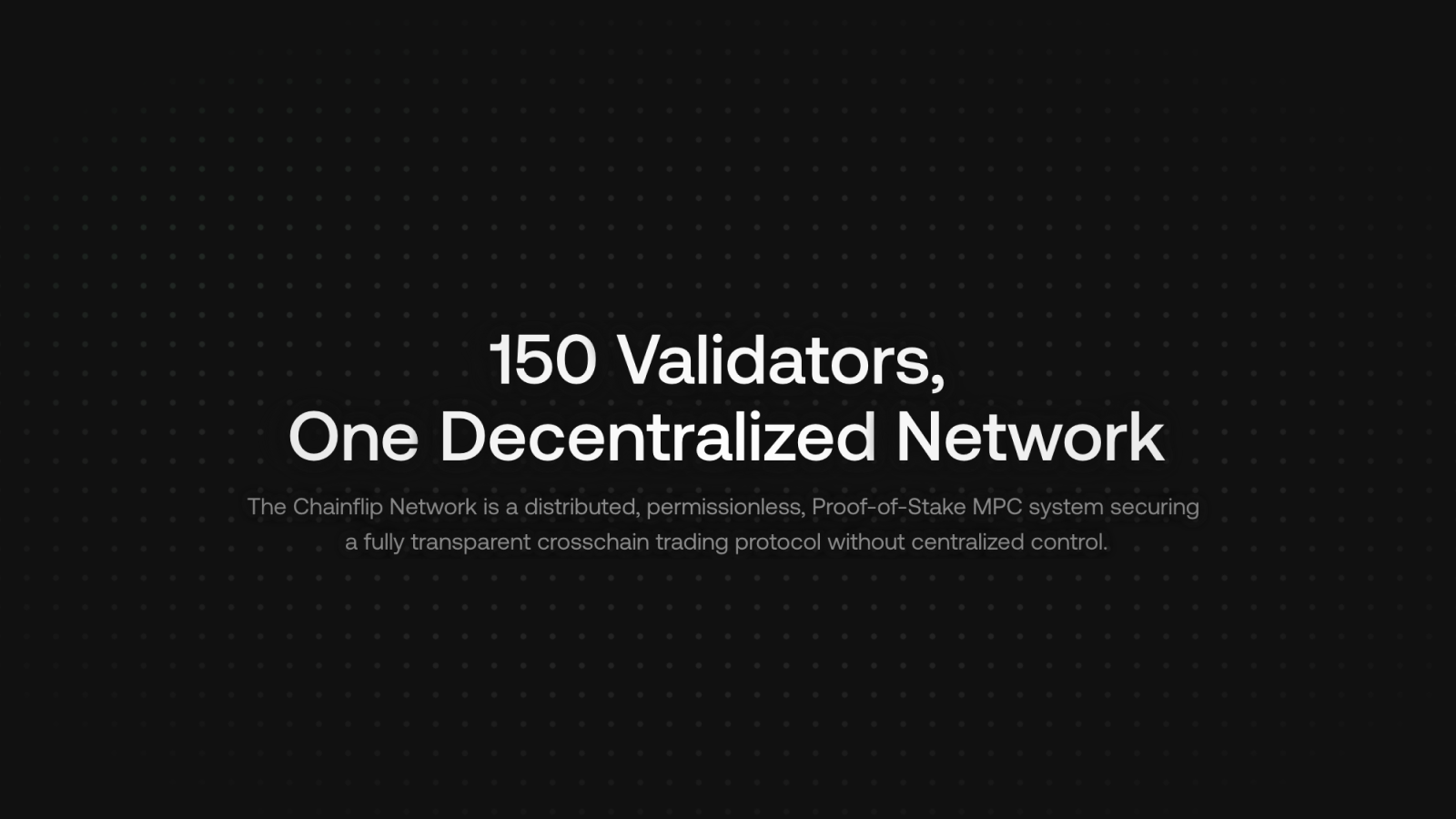
150 validators secure the network through proof-of-stake. These validators collectively control vaults on every supported blockchain using the FROST threshold signature scheme. No single validator can move funds. Signing requires consensus from a two-thirds supermajority (100 of 150).
Vault System with Threshold Cryptography
Chainflip uses its FROST threshold signature scheme to manage vaults across Bitcoin, Ethereum, Solana, Polkadot, and Arbitrum. When you initiate a swap, you send your Bitcoin to a vault controlled by the validator network. Validators collectively sign a transaction to release the destination asset from another vault.
This differs fundamentally from bridges. Bridges mint wrapped tokens. Chainflip moves real assets. Your BTC goes into a decentralised vault, and real ETH comes out of another vault. No wrapping. No synthetic tokens.
Just-In-Time AMM
Most AMMs require liquidity providers to lock capital in pools. Chainflip's JIT AMM lets market makers compete to fill individual swaps in real-time. When a swap request comes in, liquidity providers submit competing quotes. The best price wins.
LPs get better capital efficiency. Traders get tighter pricing. LPs don't need to maintain 50/50 pools across all pairs. They can deploy capital strategically and compete where spreads are attractive.
The State Chain executes the swap virtually, then validators coordinate the actual asset movements on their respective blockchains.
What Chainflip Supports
Chainflip currently supports native swaps across:
- Bitcoin (BTC)
- Ethereum (ETH, USDC, USDT, FLIP)
- Solana (SOL, USDC)
- Wrapped Bitcoin (wBTC)
- Polkadot Assethub (DOT, USDC, USDT)
- Arbitrum (ETH, USDC)
- BNB Chain (BNB, USDC, USDT) - coming soon
- Tron (TRX, USDT) - coming soon
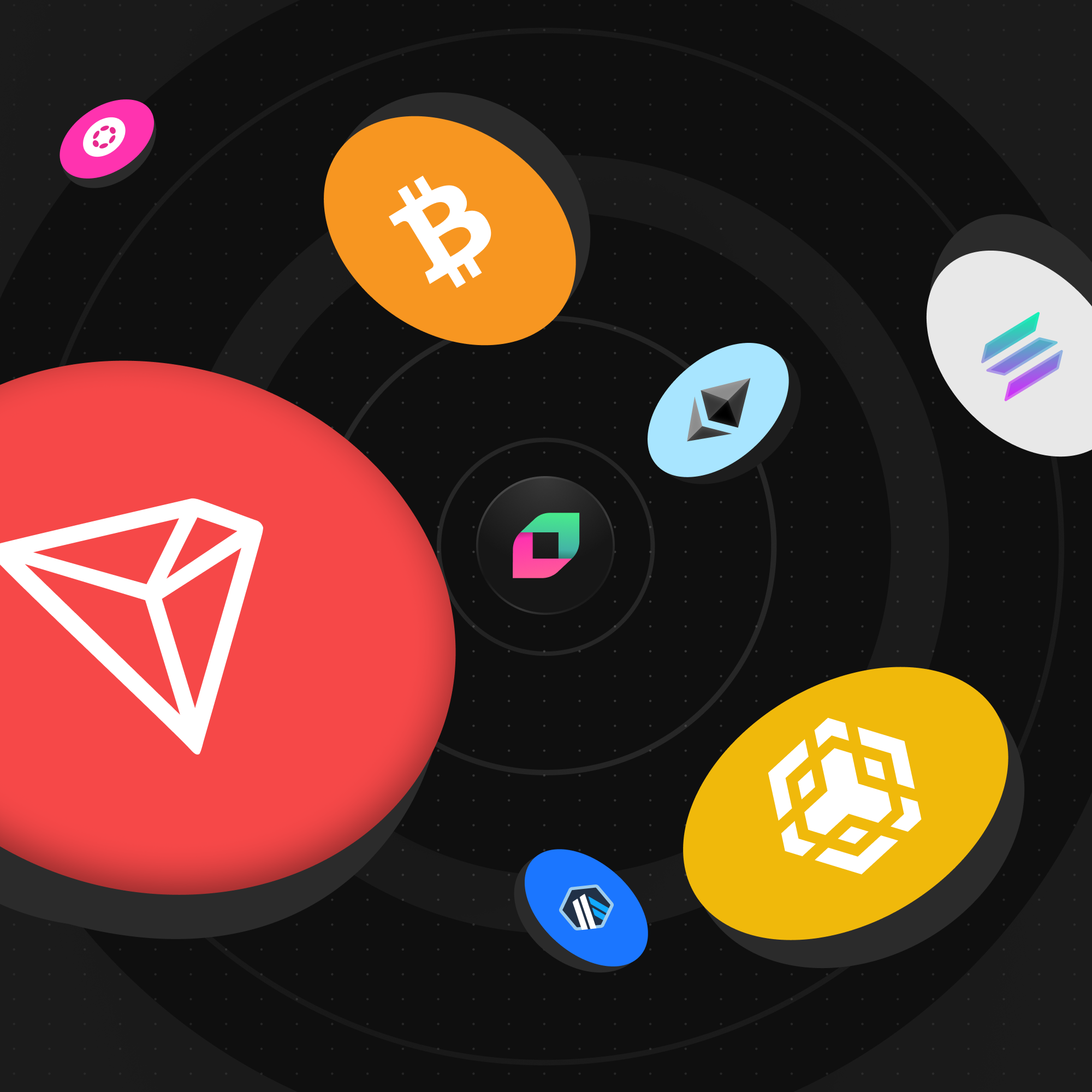
This covers the major L1s and three of the largest stablecoin ecosystems. Tron processes over $80 billion in USDT transfers monthly, mostly in Asia. BNB Chain handles significant stablecoin volume and serves as a major entry point for retail crypto users globally. Adding both chains expands Chainflip's reach into high-volume stablecoin corridors and mainstream crypto adoption hubs.
New chains are added through protocol upgrades voted on by validators. Any blockchain with threshold signature support can be integrated.
Chainflip vs Other Solutions
Here's how Chainflip compares to other DEXes bridges, wrapped tokens, and centralised exchanges:
| Feature | Chainflip | ThorChain | NEAR Intents | Bridges | CEXs |
|---|---|---|---|---|---|
| Native Assets | Yes | Yes | Yes | No (wrapped/synthetic) | Yes |
| Custody | Decentralised | Decentralised | Decentralised | Varies | Centralised |
| Execution Model | JIT AMM (market makers compete for best price) | Continuous Pools (fixed slippage curve) | Solver Network | Smart Contracts | Order Book |
| Bridge Dependency | None | None | Indirect (solvers may use bridges) | Inherent | None |
| Wrapping / Smart Contract Risk | None | None | Low | High (wrapped assets are attack vectors) | None |
| Pricing Model | Competitive (JIT bidding) | Fixed curve (pool-depth slippage) | Solver-dependent | Variable (gas on both chains) | Hidden spread |
| Cross-Chain Messaging | Yes (CCM) | No | Yes | No | Internal only |
| Permissionless LP | Yes (anyone can LP or broker) | Yes | Solver-gated | Varies | No |
| Fee Transparency | Fully transparent | Transparent | Solver-dependent | Variable | Opaque |
| KYC Required | No | No | No | No | Yes |
| Speed (BTC Swap) | ~10-30 min | 30-60 min (throttled for large swaps) | Varies | 30-60 min | Instant trade, slow settlement* |
*CEX speed refers to internal trade execution only. On-chain deposits and withdrawals add significant time and require KYC.
Chainflip vs ThorChain
ThorChain is the most direct comparison. Both protocols handle native cross-chain swaps without wrapped tokens. But there are differences worth knowing.
ThorChain uses continuous liquidity pools. LPs deposit into pools and prices adjust algorithmically. Chainflip uses a JIT AMM model where market makers compete in real time for each swap. During crashes, the JIT model tends to give tighter spreads because market makers are pricing each trade individually rather than relying on pool depth that may have been withdrawn.
ThorChain uses RUNE as the settlement asset for all swaps. Every trade routes through RUNE. Chainflip uses USDC as the base pair for most routes. This creates more predictable pricing and eliminates exposure to a protocol token during swaps.
Both protocols are non-custodial. Both handle native assets. The main practical differences come down to liquidity model, supported chains, and execution speed.
Chainflip vs NEAR Intents
NEAR Intents is an intent-based architecture where users sign a transaction expressing what they want to achieve, and solvers compete to fulfill that intent. While solving happens off-chain, settlement still touches the NEAR network. Chainflip uses an on-chain JIT AMM where liquidity providers compete to fill swaps directly through the State Chain.
The key difference is the execution layer. NEAR Intents relies on solvers routing trades through existing liquidity venues like DEXs, bridges, and aggregators. The flexibility this offers is real, but execution quality depends entirely on solver competition and the availability of third-party infrastructure. Chainflip takes a different approach by controlling its own cross-chain liquidity through validator-managed vaults. Swap routes don't depend on bridge availability or external DEX liquidity, making execution more predictable and self-contained.
Both approaches have merit. NEAR Intents can tap into a wide range of execution paths across ecosystems, which is powerful when solver competition is strong and venues are liquid. But for pure cross-chain swaps of native assets, Chainflip's vertically integrated model provides more consistent execution with fewer external dependencies, no wrapped tokens, and no reliance on third-party bridges or solver networks.
Chainflip vs Bridges
Cross-chain bridges like Wormhole and LayerZero have made significant progress in recent years, with innovations like Native Token Transfers and Omnichain Fungible Token standards. But across the broader bridge ecosystem, wrapped asset representations remain widespread, and each wrapping layer introduces additional smart contract risk.
Chainflip takes a fundamentally different approach by moving native assets directly. When you swap BTC to ETH on Chainflip, you receive real ETH from the Ethereum vault, not a tokenised IOU. This eliminates wrapped token risk and the smart contract attack surface that comes with it. Chainflip has its own trust model through its validator-managed vaults, but it removes the specific category of vulnerabilities that have plagued bridge designs.
That matters because the track record speaks for itself. Billions of dollars have been lost to bridge exploits since 2021, making bridge security one of the most significant unresolved risks in cross-chain DeFi. During high-stress periods, bridge congestion can also delay transfers significantly. Chainflip's architecture sidesteps both of these problems by keeping cross-chain liquidity under direct protocol control.
Chainflip vs CEXs
Centralised exchanges like Binance, Coinbase, and Kraken work well under normal conditions. They're fast, support more trading pairs, and handle high volume. But you're depositing assets into a custodial system, completing KYC, and trusting that you'll be able to withdraw when you need to.
That trust gets tested during market stress. In early February 2026 (February 5th & February 6th), both Binance and Bybit paused withdrawals as Bitcoin crashed over 13% below $64,000. Binance restored service within about 20 minutes, citing technical difficulties. But the timing highlighted a recurring pattern: when you need access to your funds most, custodial platforms are most likely to restrict it.
Chainflip swaps take minutes rather than seconds, and the protocol supports fewer pairs. But you never give up custody, there's no KYC, and no one can freeze your assets or halt your withdrawal. It's a trade-off between convenience and sovereignty, and during volatile markets, sovereignty matters.
Chainflip vs Wrapped Tokens
Wrapped BTC (wBTC, tBTC, cbBTC) requires trusting a custodian to hold the underlying Bitcoin. If that custodian is compromised, the wrapped token loses its backing. Chainflip doesn't create wrapped versions. It facilitates direct swaps between native assets.
If you already hold wBTC and want to swap it for SOL, Chainflip supports that too. But if you're starting with native BTC, you can skip the wrapping step entirely.
What You Can Do with Chainflip
Cross-Chain Portfolio Rebalancing
Move Bitcoin profits into Solana without touching a centralised exchange. Swap stablecoins from Ethereum to Arbitrum to deploy in lower-fee environments. Rebalance portfolios across chains without multiple bridge transactions or wrapped token exposure. Swap here.
Native Bitcoin Access to DeFi
Bitcoin doesn't natively support the smart contract functionality found on chains like Ethereum. To use BTC in DeFi, most solutions require wrapping it into wBTC or tBTC on Ethereum. Chainflip lets you swap native BTC directly for any supported asset. Bitcoin holders get access to DeFi ecosystems without custodial wrappers. You can even deploy your BTC into Chainflip's very own Boost product which lets you earn native BTC Yield.
Native Bitcoin Lending
Chainflip Lending launched in February 2026. Users can deposit native BTC and borrow USDC, ETH, or SOL on other chains. No wrapped collateral. You keep your BTC on Bitcoin, but borrow against it on Ethereum or Solana. Liquidations happen through the Chainflip DEX. A closed-loop lending market without external dependencies.
Stablecoin Strategies
Moving stablecoins between chains usually means bridging, paying gas on both ends, and sometimes ending up with a wrapped version on the destination chain. Chainflip handles stablecoin swaps natively in a single transaction. Send USDC on Ethereum, receive USDC on Solana directly. For stablecoin holders looking to earn yield, Chainflip's Automated Stablecoin Strategies let you deposit into the protocol's liquidity system and earn passively from swap volume across every trading pair, without directional exposure to volatile assets.
The FLIP Token
FLIP is Chainflip's native token. Validators stake FLIP to participate in network consensus. The more FLIP staked, the more economic security the network has.
Chainflip charges a 0.1% fee on every swap. This fee is used to buy FLIP from the market and burn it. As of February 2026, Chainflip had processed over $6 billion in cumulative swap volume (Chainflip Scan), burning significant amounts of FLIP weekly.
FLIP 2.0 reforms are in development. The goal is to improve staking incentives and align validator rewards with protocol revenue. The transition moves FLIP from an inflationary emissions model to a revenue-sharing model where validators earn from protocol fees directly. You can stake your FLIP directly in our platform.
You don't need FLIP to swap on Chainflip. Swap fees are paid in the asset being swapped, not in the protocol token.
How to Use Chainflip
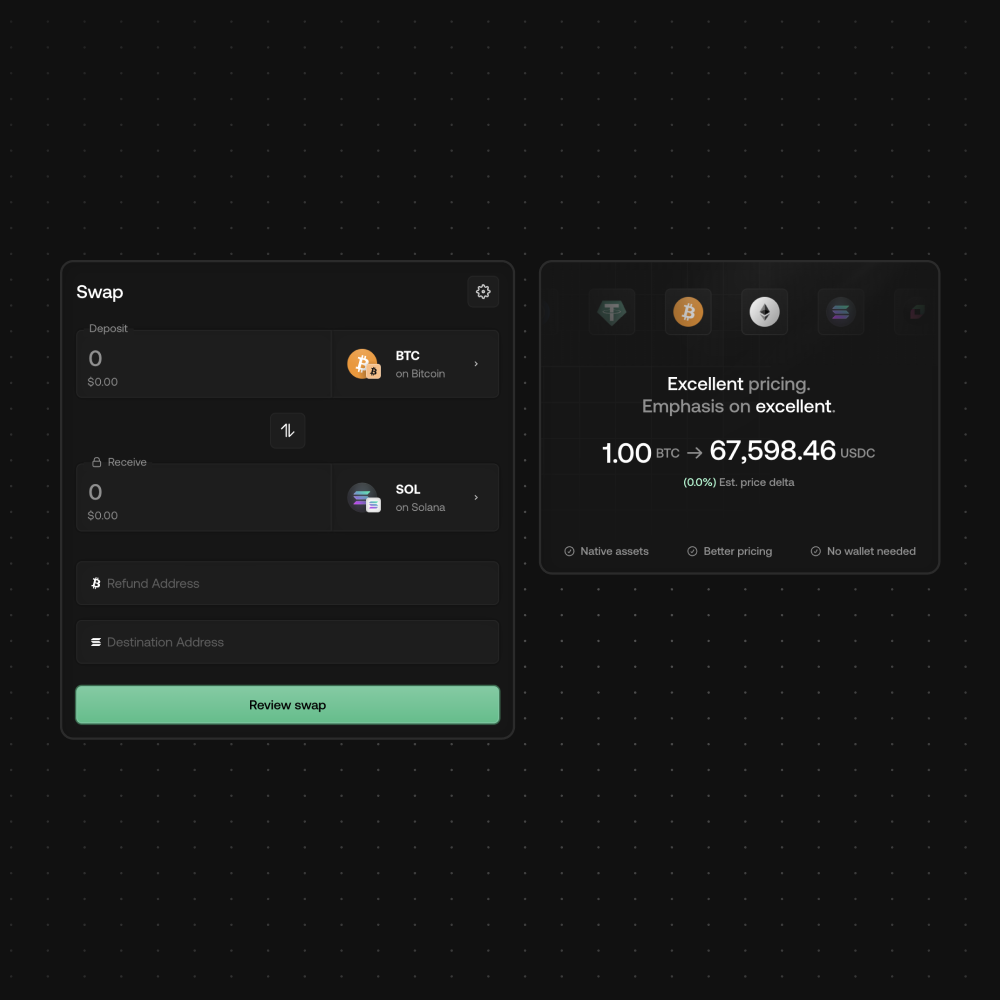
Using Chainflip to swap is straightforward. No wallet connection required (unless you want transaction history tracking).
- Go to swap.chainflip.io
- Select your source asset and destination asset
- Enter the destination address where you want to receive funds
- Initiate the swap by sending assets to the generated deposit address
- Track progress via the swap ID or on Chainflip Scan
Swaps typically take 2-5 minutes for Ethereum, Solana, and Arbitrum. Bitcoin swaps require 3 block confirmations for security, usually 10-30 minutes.
For customer support on swaps, redirect here.
For Liquidity Providers
Chainflip's LP system uses a JIT AMM where market makers compete to fill swaps. LPs can deploy capital across pairs and earn fees by providing competitive quotes.
The LP app at lp.chainflip.io lets you deposit assets, set pricing strategies, and monitor performance. Automated stablecoin strategies are available for passive LPs who want yield without active management.
Integration Into Wallets and dApps
Chainflip powers more than just the standalone swap app. Our SDK lets wallets, aggregators, and dApps integrate Chainflip as their cross-chain backend. SafePal (25 million users), Phantom, MetaMask, Trust Wallet and others have integrated Chainflip. Native cross-chain swaps now live directly inside these interfaces.
For Developers
The SDK provides a TypeScript library for integrating Chainflip into wallets, aggregators, and dApps. Documentation at docs.chainflip.io covers RPC endpoints, swap requests, and cross-chain messaging.
Aggregators can query Chainflip routes alongside other liquidity sources to surface the best price for users.
Chainflip: Moving Towards Becoming a BTC Hub
Chainflip started as a cross-chain swap protocol. That foundation is now expanding into something broader: a decentralised hub for native Bitcoin.
In early 2026, Chainflip launched native BTC lending, the first permissionless, cross-chain lending market for native Bitcoin. Users can now lend and borrow BTC, ETH, SOL, and stablecoins directly across chains without wrapped tokens or centralised intermediaries. The lending system is built on the same threshold signature vault infrastructure that secures billions in swap volume, and uses soft liquidation mechanisms that settle through Chainflip’s own DEX rather than relying on external actors.
This matters because wrapping BTC into wBTC or cbBTC is treated as a taxable disposal event in most jurisdictions, defeating one of the core purposes of over-collateralised lending: accessing value without triggering a sale. Despite this, Aave alone holds over $4.3 billion in WBTC collateral, showing the demand. Chainflip’s native approach lets BTC holders borrow against their holdings without ever leaving the Bitcoin network.
Once Chainflip Liquidity Lending (CLL) is released we will allow market makers to borrow capital on demand from lending pools to fill user swaps with only a fraction of their own inventory. We will also soon introduce the Lending SDK, enabling developers to integrate lending functionality directly into their applications, wallets or protocols.
Together, swaps and lending create a compounding economic model. Lending generates new revenue through interest, origination, and liquidation fees. Liquidations generate order flow for the DEX. More DEX activity drives more LP participation. All lending revenue feeds into the same buy-and-burn mechanism that supports FLIP’s value. Q4 2025 already delivered record results with $1.69 billion in swap volume and $994K in network fees from swaps alone. Lending is expected to add up to $100 million in annual revenue depending on adoption.
The trajectory is clear. Chainflip is evolving from a single-purpose swap protocol into multi-product liquidity infrastructure with Bitcoin at its centre. Native BTC swaps, native BTC lending, and soon liquidity-backed execution, all secured by the same decentralised validator network and threshold cryptography. No bridges, no wrapped tokens, no centralised counterparties. Just native Bitcoin.
The Bigger Picture
Cross-chain swaps are infrastructure. Most users don't care about the underlying protocol when swapping tokens in their wallet. They want the best price and a smooth experience.
Chainflip powers that experience invisibly. Wallets integrate Chainflip. Users click swap. Chainflip routes the transaction in the background. No bridges. No wrapped tokens. No friction.
As more products and chains launch, liquidity fragments further, and the need for native cross-chain infrastructure grows. Chainflip builds the rails for that future.
By January 2026, Chainflip had processed over $6 billion in swap volume. Integrations with SafePal, Phantom, MetaMask, TrustWallet, and others brought Chainflip routes to millions of users. Native Bitcoin lending added a new product vertical beyond swaps.
New chains will come. New features will ship. The core thesis stays the same: native assets, no bridges, permissionless.
Your Bitcoin doesn't need a wrapper.
───
Resources
- Swap Now — Start swapping native assets
- Chainflip Lending — Borrow against Bitcoin
- Documentation — Technical guides and protocol details
- Blog — Product updates and announcements
- Chainflip Scan — Track swaps and network activity
- Website — Chainflip Homepage
Join us on Discord: https://discord.gg/chainflip-community
Join us on Telegram: https://t.me/chainflip_io_chat

Chainflip Website
───
Frequently Asked Questions
What is Chainflip?
Chainflip is a decentralised cross-chain swap protocol that enables native asset swaps across Bitcoin, Ethereum, Solana, and other blockchains without bridges or wrapped tokens.
Is Chainflip safe?
Chainflip is secured by 150 validators using threshold signature cryptography. The protocol has been audited multiple times with no major security incidents since launch in late 2023. Over $6 billion in swaps have been processed.
Do I need KYC to use Chainflip?
No. Chainflip is permissionless. No account creation, no identity verification, no email signup.
How long do swaps take?
Ethereum, Solana, and Arbitrum swaps take 2-5 minutes. Bitcoin swaps require 3 block confirmations for security, typically 30-40 minutes.
What are the fees?
Chainflip charges a 0.1% protocol fee. Network fees for the source and destination chains apply separately. Market maker spreads vary based on liquidity and pair.
Do I need FLIP tokens to swap?
No. Swap fees are paid in the asset being swapped. You only need FLIP if you want to become a validator or participate in governance.
Can I swap native Bitcoin on Chainflip?
Yes. Chainflip supports native BTC swaps to ETH, SOL, USDC, USDT, and other supported assets. No wrapping required.
What's the difference between Chainflip and a bridge?
Bridges create wrapped token representations (e.g., wBTC on Ethereum). Chainflip moves native assets directly between chains using threshold-controlled vaults. No wrapped tokens, no bridge risk.
What happens if my swap fails?
If a swap fails due to insufficient liquidity or a validator issue, funds are automatically refunded to your source address minus network fees.
Which wallets are supported?
Any wallet that can send and receive native assets works with Chainflip. No wallet connection is required. Popular integrations include SafePal, THORWallet, and Phantom (via aggregators).
What is the minimum swap amount?
Minimum swap amounts vary by asset and chain to cover network fees. Bitcoin minimums are typically around 0.001 BTC. Ethereum minimums are around 0.01 ETH.
What's the maximum swap amount?
Swap limits depend on available liquidity. Large swaps may experience slippage. The protocol supports swaps up to several million dollars when sufficient liquidity exists.
How does Chainflip make money?
Chainflip charges a 0.1% fee on all swaps. This fee is used to buy FLIP tokens from the market and burn them.
Is Chainflip decentralised?
Yes. Chainflip operates as a permissionless validator network. No central party controls the vaults or can censor transactions. Governance happens through validator voting.
Can I provide liquidity on Chainflip?
Yes. Liquidity providers compete to fill swaps through Chainflip's JIT AMM. Visit lp.chainflip.io to get started.
What chains will Chainflip support next?
BNB Chain (BNB, USDC, USDT) and Tron (TRX, USDT) are coming soon. Future integrations depend on validator votes and technical feasibility. The protocol prioritises chains with large user bases and liquidity.